Saturday, June 8, 2013

Stuttgart Frühlingsfest

Okay, time to play catch up before I leave for Greece...

The weekend of May 4th and 5th, I got to meet up with some old friends from school in Stuttgart. While we were there, we attended the "more authentic" festival in Germany known as "Frühlingsfest" (spring festival). It's less touristy than Oktoberfest but has all of the festivities that go along with German festivals. Basically, it is a combination of a state fair with the classic fair rides and Oktoberfest with beer tents, dancing, and partying.


I met up with Kylee (she was an ICP student a few years ago) and Joe and Chris (guys from SigEp)! It was great to see all of them because I haven't seen any of them for a long time. We had a table reserved for Saturday night from 4:00pm to 11:00pm, and I have to admit that I was a little bit weary. Could anyone really party for that long? And could these guys do it having just landed in Germany a few hours before?

We met up with some of Kylee's friends from her stay in Germany, some from England and others from Germany, and the partying commenced. My favorite part about German parties is that they love to sing songs and dance and act crazy. I would compare it to a combination of a wedding and a pop concert in the US. One of my favorite songs is "So ein schöner Tag" (such a beautiful day), which has a bunch of dancing motions. Many people dress up in Lederhosen and Dirndl, mostly ironically. Everyone is standing on wooden benches singing and dancing with the motions to swim, jump, and fly!  This is not my video, but it give you an idea of the epicness of the situation! It's a crazy and awesome experience!


Here I met some new friends from England named Rosanna and Bethany and some new friends from Germany named Kristoff and Karolin! It was a fun group to be a part of. We ate dinner in the tent, which consisted of have a chicken and a dinner roll. Typical German food and quite delicious.


We actually stayed until the end of the night dancing and singing to music from both a live band and a DJ, and I'm still amazed that Kylee, Joe, and Chris were able to make it the whole night. Chris looked pretty tired at several points throughout the night, but you're only in Germany for a short amount of time so you might as well live it up! It also amazes me all of the American songs that are big hits in Germany. Some of them know songs that I've never even heard before.


The next day, we explored Stuttgart a little bit and went back to Frühlingsfest to ride some of the rides and eat some fair food, of course! Rosanna was my buddy for this as she and I basically were dragging everyone else around to the different rides. We road the largest and fastest transportable roller coaster (which is awesome, but I think if you need to add qualifiers, it becomes less impressive). At the recommendation of Kylee, we also had to try Feuerwurst ("Firewurst"), which is a spicy bratwurst. It was really quite delicious, although I should not have eaten it in the middle of our riding extravaganza.


Sunday, May 12, 2013

Porto, Portugal

On the weekend of April 19-21, I was in Portugal. Almost immediately, I fell in love with the city. I won’t lie to you, many of the buildings are corroding and crumbling, but the city is absolutely beautiful.

First, I stopped by my hostel to drop off my things. The woman working the desk was incredibly friendly and helpful. One of the bonuses (I guess) to not fully planning out my trips is that I get a wonderful opportunity off the bat to talk to my hosts and learn what they love about the city. This woman was so excited that she laid out more things than I could fit into only a weekend!


I walked through the central area of the city down to the river, just meandering my way around, stopping to take pictures of anything I found interesting. I walked by old buildings, beautiful churches, remains of castles, and finally made it to the Douro River. This river made Porto a huge port city, running from Spain all the way to Porto on the Atlantic Coast. I crossed over the Ponte Luís I (Louis I Bridge), and took some pictures of the city with the river in the foreground. It’s amazing because Porto is such a hilly city that you can see many buildings as the city rises up from the river.


Portugal is believed to have gotten its name from the combination of Porto and the area north to the Minho River (another large river emptying into the Atlantic Ocean), known as Cale (pronounced: "call-a"). The name Portocale eventually transformed to Portogale and finally evolved into Portugal as we know it today. It's interesting to know that I was in one of the cities that played a major role in the namesake of the entire country.


From the bridge, I walked along the river, seeing many of the wineries that Porto is known for. If you have ever heard of Port Wine, this is where it comes from. I walked along the river until I got to the Atlantic Ocean, and then I walked along the beach. I took my shoes off to walk in the sand and test the water (which was incredibly cold by the way). Unfortunately, the sand in Porto was very rough. It was not the thin grain, soft sand I was used to. Rather, it was coarse and rough on my feet. I walked along the beach, saw two lighthouses that directed boats into the port from the ocean, and really just relaxed. It was very peaceful.


Later that night, I tried to make my way back to the beach to take pictures at sunset, and only just barely made it. I was able to catch the last few glimpses of sunlight. Fortunately, I was able to salvage the situation by taking pictures of the stars over the ocean as it got darker. I think they turned out pretty well!


Saturday, I took a tour, which will be elaborated on in my next post, but I also met a lot of really cool people. One guy was wearing a Steelers hat (he was from Italy, but he likes American Football)! I met a girl who was living in Amsterdam but was originally from New Zealand and was visiting with her mother. I met two girls studying in Maastricht, Netherlands: one was from South Africa and the other from Russia. There was a guy from Australia and another from Chile, plus a young couple from Mexico City. Basically what I’m getting at is that our group consisted of people from 6 of 7 continents.


A group of three German women was also on the tour, and their English was very rough. Once I told them that I spoke a little bit of German, I became their unofficial translator. I only had to help with a few of the details, but overall, they got most of what was going on. It was fun and frustrating because most of the words that they didn’t know were difficult to come up with in German, but we got all of them sooner or later! These women were about to partake in a pilgrimage known as “El Camino de Santiago” or Way of St. James. They would walk from Porto to the Cathedral of Santiago de Compostela in northwestern Spain, spanning nearly 225 km or 140 miles. Not an easy trek for women in their 50s.

Later that night, I was finally able to get my sunset pictures. Some of them turned out really great, and I was able to get a picture similar to one of our rush shirts for SigEp!


On Sunday, I took a bus out to Geres (pronounced [roughly]: “jza-resh”). Best of luck with that one. Geres is a national park in the northeast of Portugal near the Spanish border. Once my bus dropped me off, I was in a small town just outside the park and had no idea where I was supposed to go. Of course, once you get out into small towns like these, you are lucky to find anyone who speaks anything other than Portuguese. Luckily, one of the younger girls at a diner struggled through her rough English vocabulary to help me figure out where to go.


I have to stop and say that not very many people I met in Portugal spoke English. However, even if they didn’t understand a word I was saying and I didn’d understand a word they were saying, they were incredibly patient and tried to be as helpful as possible. I appreciate the effort they made to help me out. It was really cool to meet people who were friendly and tried everything they could think of to help.

At the national park, I came across some beautiful landscapes, a bunch of lizards, some wild horses, and a really awesome waterfall, among other things. Words literally can't describe, so I'll just let you look at the pictures! This was a really refreshing change from the city experiences I am accustomed to having in Europe.


When I was heading back, the bus was late. After about 10 minutes I started to get a little bit concerned. I was two hours from Porto in the middle of nowhere. When the bus was 20 minutes late, I decided to go ask someone. If I was stuck here, I would miss my flight in the morning and have to pay a lot to get back to Germany. I talked to someone in the diner and they told me not to worry and that buses are typically late in Portugal. This bus was now half an hour late, and I was trying my best not to completely lose it. After 45 minutes, the bus showed up and everything in my world settled back to a normal level of calm. I guess the lesson we can take from this is that the Portuguese do things on a very delayed schedule.

Anyway, my time in Portugal was an incredible one, and I think that it is the coolest place I have visited while I’m here in Europe.

Wednesday, April 17, 2013

Tour of Amsterdam

I will summarize my tour of Amsterdam in four parts this time (four?! Yes four). Just so you know, I summarize these mostly so I can eventually go back and revisit them, but I put them online in case any of you want to know what I’m learning! :P

The four parts we’re going to dive into are Fun Facts (and any miscellaneous information I couldn’t figure out where it should go), History and of course, you can’t talk about Amsterdam without mentioning Prostitution and Marijuana.

Unofficially, the Dutch have a philosophy that will pop up in many aspects of their culture: a “Tolerance Policy”. They will “look through their fingers” only seeing the benefits of certain things if they fit into three criteria.
  1. It is kept relatively quiet
  2. It does not cause any harm
  3. It must generate money and boost the economy
I mention this first to give you insight into the business mindset of many Dutch people.

Let’s start with some FUN FACTS!

  • The #1 crime in the Netherlands is tax evasion
  • Amsterdam is known for its canals built around the city (“Venice of Northern Europe”), but unlike in Venice, these canals are filtered every three days to prevent that dirty water smell in the hot summers
  • Each year, approximately 20,000 bikes are pulled out of the canals. College students like to teach people to lock their bikes up properly the hard way.
  • If the winter is cold enough, the canals will freeze over. The Dutch love ice skating, and it is not uncommon to see people skating to work or the store. When this happens, they will have a race to identify a King or Queen of the Canals
  • The British call cookies “biscuits”, so where did the work cookie come from? The Dutch word cookja (“cook-ya”), showing their influence on the United States (which I will talk about later)
  • The Dutch are also good engineers. They built in the corners of buildings in alleys “pee deflectors” to discourage drunken people from peeing there. These deflectors will cause the urine to splash back onto the perpetrators pants. At one point, they were electrically charged, but someone turned up the power too high and… you can guess from there.

  • Amsterdam is a city built mostly below sea level. Its highest ground elevation (not buildings) is 1.3 meters above sea level. The Airport is 3.5 meters below sea level.
  • Because of its low altitude, rats can be a problem. Therefore, many people have cats to deal with this problem, including many of the coffee shops (places where you can smoke pot). It is not uncommon to see stoned cats in these shops.
  • Taxes on buildings were determined based on their width. Thus, you have many thin houses; the smallest of which is 1.6 meters (just over 5 feet) wide.

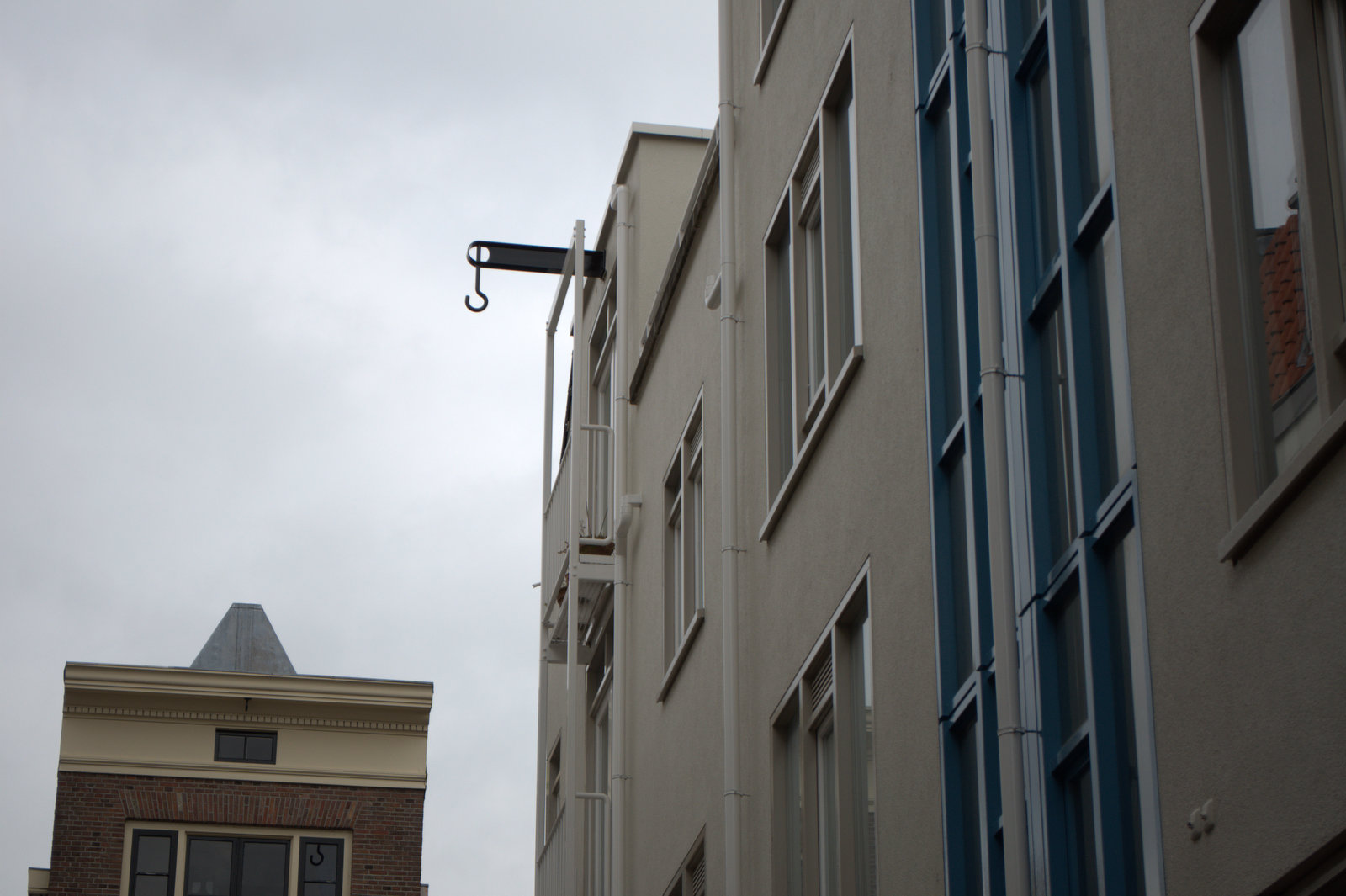
  • Because many buildings are thin, their staircases are also thin and steep. You can’t really get furniture or large objects up the stairs, so they attach a hook from the beam at the top of the house to use as a pulley system. People will use these pulleys to lift sofas, fridges, and just about anything else you can imagine.

  • There are many leaning buildings in Amsterdam. Some lean on purpose and others are mistakes:
    • Buildings that lean to the side are a result of faulty foundations
    • Buildings that lean forward are an incredibly intelligent showcase of engineering. They must lift heavy things into their houses using pulleys, but Amsterdam is quite windy. Oftentimes, people would accidently break their windows or damage the house itself performing these tasks until they starting leaning the building slightly forward! Crazy right?!

  • Amsterdam was the first city to have a monument to represent homosexuals and their gay pride parade actually takes place in the canals

  • Clogs (the wooden shoes) were originally used by factory workers to protect their feets (they might be the first version of the steel toe boot).
  • The Dutch and their sports teams often wear orange, even though their flag is red, white, and blue. This is because the royal family is the House of Oranje-Nassau, dating back to Willem van Oranje (William of Orange). Thus, the color originates from the name of their royal lineage but is today a sign of pride in their country and heritage.

BRIEF HISTORY:

Dam Square, an actual dam blocking part of the Amstel River, is the central location of Amsterdam built in the 13th century. In 1645, the royal palace was built here as Amsterdam was developing into one of the most important European cities (their “Golden Age”)

During the 16th century, Catholicism was banned in Amsterdam after Protestants took power. Many Catholics remained in the city despite this ban because citizens would “look through their fingers” at those practicing the Catholic faith. One famous Catholic Church, Ons' Lieve Heer op Solder (Our Lord in the Attic), as you may be able to guess, continued to hold service throughout this 200 year ban on Catholicism in secret. The Church in the attic was able to hold nearly 200 people.

 What is now the University of Amsterdam is considered the birthplace of modern capitalism. This is where the headquarters of the Dutch East India Company (in Dutch, Vereenigde Oost-Indische Compagnie or “VOC”) originated. You may be familiar with this for many reasons, the most important of those reasons being that this is how Captain Jack Sparrow is identified as a pirate by Commodore Norrington in the beginning of the first Pirates of the Caribbean movie (no I’m not embarrassed that I didn’t have to look up any of that information).


The VOC had four major enemies: storms on the seas, disease, enemies of the Netherlands, and of course, pirates. However, they responded very well to these problems. They had a fleet of 20 ships sailing back and forth from the Netherlands to the new world. Instead of loading each ship entirely with one good, as was the custom at that time, they would load 5% of each product on every ship. That way, if they lost one ship, they would only lose 5% of each of their products and still have 95%. The first stock exchange building in the Netherlands (maybe in the world; up for debate) was built in Amsterdam, and people received 400% returns on the East India Trading Company stocks.

In 1626, the Netherlands purchased an island for the modern equivalent of $27 and named it “New Amsterdam”.  Later, this island was traded for the Island of Run, a small island that was mostly jungle. This trade was a bad one for the Dutch and was referred to as getting an apple for an egg. They traded away Manhattan, a.k.a. “The Big Apple”. The nickname is believed to have arisen from the Dutch metaphor condemning the trade. However, the melting pot that Amsterdam was at the time due to its successful commerce and economy resulted in a similar array of people in New Amsterdam—thought to be a leading cause of the diversity of New York City.

Fast forward to World War I, and we have the business-minded Dutch wanting to stay out of the costly effort that is war. However, they took advantage of the opportunity to make a profit selling weapons to both sides. In World War II, people in Amsterdam would “look through their fingers” at Jews, which led to Amsterdam receiving the nickname of “Jerusalem of the West”, a safe haven. Unfortunately, Hitler conquered Amsterdam, but the city was left mostly alone.

Here we have two interesting stories. The first is about a group of Jews who formed underground boxing clubs. They heard about plans of a Dutch Nazi attack nearby, jumped them, and beat their leader into a coma. He would die three days later causing a strong response from the Dutch Nazis. They planned yet another attack the following day, a Sunday. Sunday was market day, and the workers went on strike to stand up to the Nazi occupation. Although the Nazis responded with heavy artillery, quickly disbanding the strike, this is a moral victory for Amsterdam. This is the only time in WWII that a non-Jewish population of a city stood up to defend the Jewish population of their city.

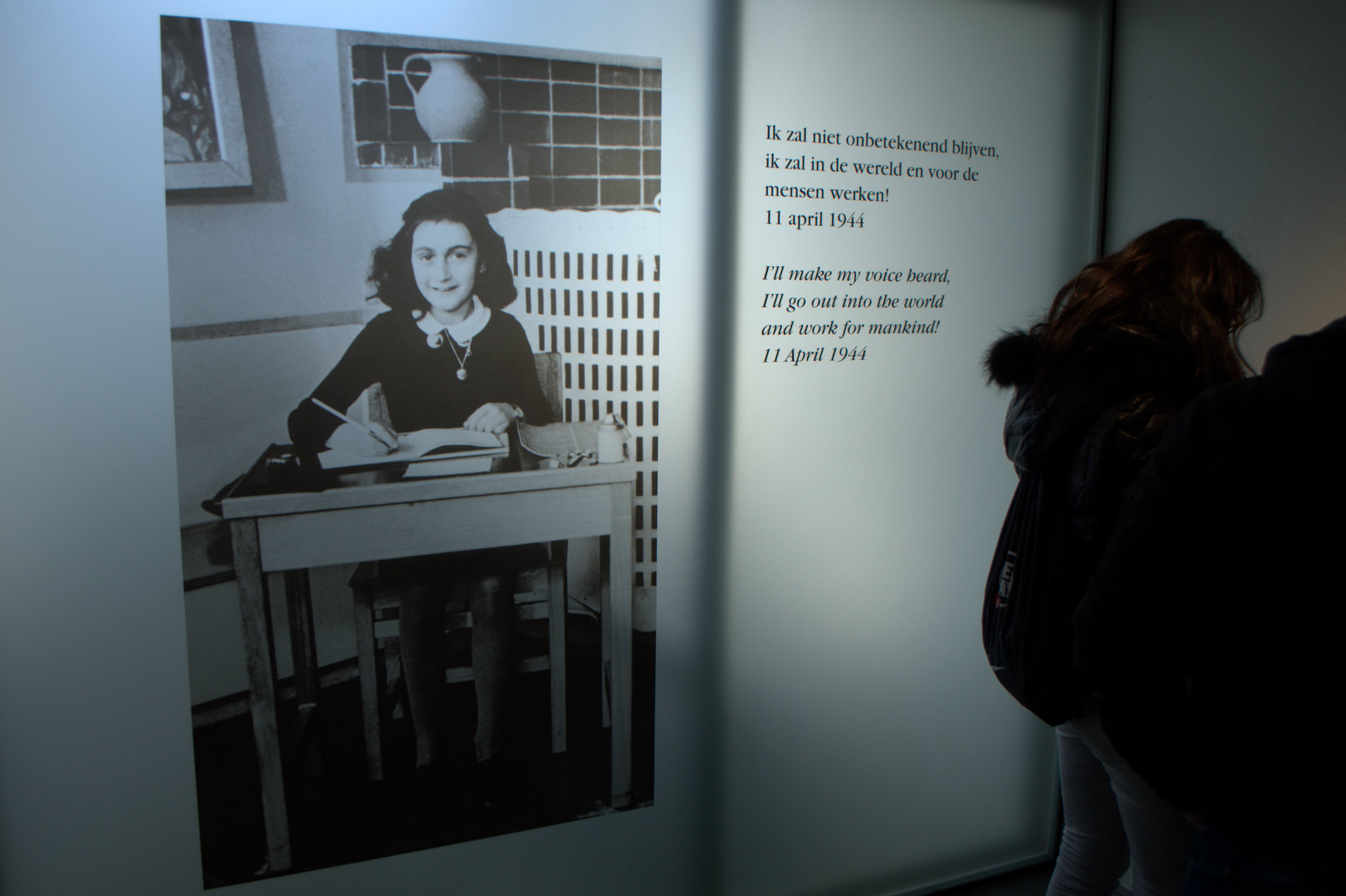
Of course, we have a second story, one of the most famous tales of WWII: Anne Frank. Born in Frankfurt am Main, her family moved to Amsterdam to escape Nazi Germany. Her father, Otto, began a very successful jelly business there. In his business, he constructed a secret annex where his family and four others hid from the Dutch Nazis during the Nazi occupation of Amsterdam. With the help of his trusted business partners, they hid for over 2 years.


In hiding, she wrote in her diary to escape and share things she could not share with the people in hiding with her. The house is filled with powerful quotes from her diaries indicating how she longed to laugh or even cry but could not for fear of someone outside hearing her. She also read many books while in hiding. Her father encouraged her to keep a book of her favorite quotes from the books she would read. Anne aspired to be a successful writer after the war, so when the exiled Dutch government announced over the radio a request to save diaries and journals from Jews hiding during the war, Anne saw her opportunity. She rewrote almost her entire diary before she and her family were found as a result of an anonymous tip (to this day, nobody knows who betrayed their family).


When they were captured, her diaries were left in her father’s briefcase under his bed. Helper to the Franks, Miep Geis, found the diaries and hid them, even though this act was punishable by death, hoping to return them to Anne after the war. Unfortunately, Anne, her sister, and her mother, died before the end of the war. Anne died just one month before the Nazis surrendered. Miep gave the diaries to her father upon his return and, determined to fulfill her goal of being a published writer, had the diary published. Her diary and stories are now published in 37 different languages.


The Dutch Police helped the Nazis in uncovering many Jews hiding in the Netherlands. The Jewish population went from 140,000 to 5,000 after the war. Because of the government’s harsh betrayal of the citizens of the Netherlands, many new, liberal laws arose after World War II. Included in these laws are the well-known, liberal drug and sex laws.

Prostitution:

 Very famous in Amsterdam is the Red Light District, known for its availability for sacrilegious activities. Yet somehow, we have a church (The Old Church built in 1307) smack dab in the center of this area. Now what in the world is a church doing there?! There are two reasons. First, the sailors coming into town that didn’t know their way around the city could head to the Red Light District, do their dirty deeds, and stumble straight over to the church to ask for forgiveness. The priests would give “indulgences” vindicating sailors for a fee.

However, many sailors would have to leave very early and would not have enough time to stop by the church before they had to ship out. It’s a very dangerous thing to be sailing the rough seas with such bad deeds hanging over your head, so the church began selling “pre-indulgences” where sailors could confess for sins they intended to commit the following night. The church was shut down shortly after they posted a price list next to the confession box for different sins.

The church also had a second, lesser-known purpose. To this day, time slots with prostitutes last 15 minutes and are often timed using musical playlists. Before stereos and playlists, the time slots would be according to the church’s bells, ringing every 15 minutes.

In the year 2000, prostitution was legalized in Amsterdam in an effort to cut down on the sex trafficking and forced prostitution occurring there. Nowadays, prostitutes can rent the windows they dance in for 75-150 Euros per day (approximately $100-200). Quite an upfront cost, but when you work in 15 minute shifts and charge (typically) 50-70 Euros (just under $100) per customer, you end up making a fair amount of money.

Beware! If you are traveling to the Red Light District in Amsterdam, you will see these ladies dancing in windows along the streets. Do not take their pictures! The windows open, and one of two things will happen. One: they will chase you down, break your camera, and probably hurt you as well. Two: they rent windows and have a strict time schedule and usually do not have access to a bathroom. They pee in cups and will use this to make you pay if you take their picture. You don’t want to walk around smelling like prostitute urine, I promise.

Despite its well-known nightlife reputation, the Red Light District is actually a very friendly and family-oriented area during the daytime. We walked through seeing parents with their kids and enjoying the nice day.

Marijuana:

 Marijuana is another thing that is allowed in Amsterdam by the Dutch “looking through their fingers”. It is relatively quiet, people who smoke pot aren’t generally causing trouble, and it is great for their economy. Profits are estimated at nearly 283 million Euros, probably more due to lenient tax laws around sale of weed. In the 70s, heroine was a big problem in Amsterdam so efforts were strengthened against heroine and were more casual when it came to marijuana. However, you do have to be 18 years old to smoke it.

The name of “Coffee Shops” arose in an effort to not directly come out and say they were selling marijuana, allowing officials to “look through their fingers”. They cannot directly advertise the sale of pot nor have menus, but many places do. Some menus include what kind of marijuana you are getting, how it will be ingested or inhaled, and a vivid description of the high you will feel as a result.


Despite the fact that it is allowed, the Dutch government has been quoted as saying that they have succeeded in making marijuana a boring drug. People in the Netherlands still smoke it. Kids will try it before they are legally allowed, but it becomes less appealing as they get into college. Studies have proven that weed inhibits short term memory, which is imperative for college students. Overall, the Dutch are below average in marijuana use per capita.

Tuesday, April 16, 2013

Tour of Paris


My tour of Paris will be broken down into two parts: Brief History and Interesting Facts

Brief History:

Paris was originally inhabited by a Celtic tribe on the Ile de la Cite, an island on the La Seine river (the main river flowing through Paris). This civilization was, like many others, massacred by the Romans in their quest to conquer the world. Fast forward to 1163, and we have in the exact same place the beginning of construction on the Notre Dame de Paris (“Our Lady of Paris”), which was completed in 1345.

Napoleon Bonaparte (Napoleon I) was crowned as the Emperor of France here in 1804 by Pope Pius VII. He, being the arrogant little man that he was, physically took the crown from the Pope and placed it on his own head, claiming that he did not “owe his crown to any divine power” and did not hold a position below the Pope. He also, in an effort to revitalize Paris, planned to demolish Notre Dame de Paris. Fortunately, Victor Hugo (famous writer from Paris), in an effort to save the cathedral, wrote Notre Dame de Paris, known to us as The Hunchback of Notre Dame, which effectively secured the Notre Dame as a landmark and saved it from destruction.

Now let’s backtrack to King Louis IX in the 1200s. He viewed Paris as the “New Holy Land”, thus he actually went out and bought the Crown of Thorns that is thought to have been worn by Jesus himself. He also purchased a part of the cross and one of the nails used in the Passion of Christ. The cost for such precious artifacts, an equivalent cost of over $1 million.

Fast forward to King Henry the IV – the “People’s King” – named because he was one of few monarchs to ever be genuinely loved by the people he ruled over. Part of this love arose from his decree that every man was entitled to a roast chicken dinner on Sunday. If they could not afford it, he would provide it for them. Despite how loved he was as king, he almost was not crowned because he was protestant. However, one morning he woke up and declared himself catholic so he was crowned as the King of France. Eh, why not.

He is credited with the idea of building the first bridge of stones in Paris. He wanted a bridge that would not burn down. Thus, he ordered the construction of Pont Neuf, the oldest bridge remaining in Paris. Being incredibly proud of his idea, he hosted a celebration with the King’s collection of wine and champagne. He wanted people to have souvenirs to remember the day, and so he ordered artists to paint portraits of the attendants. Unfortunately many of them were too drunk to make it home with the portraits, and they would surely litter the streets. So the good king saved the portraits and had the faces carved in stone and placed around the bridge. That is why the face of one man (there are actually a few) about to “blow chunks” appears on the bridge, probably because he was about to throw up when the portrait was painted.


Unfortunately, declaring yourself Catholic does not sit well with staunch religious folks. Thus, twenty-four unsuccessful attempts were made to take his life. However, on the 25th attempt, Francois Ravaillac succeeded. He stabbed the king multiple times, but did not kill him. King Henry IV said, “Is that the best you’ve got?” Ravaillac then stabbed him in the heart to ensure the dead was done. Sadly for Ravaillac, he was captured, and the penalty for killing a beloved king is a harsh one. The French were contemplating new kinds of torture and tested them on Ravaillac. His bones were broken with wooden mallets; he was burned with sulfuric acid, and was pulled apart by horses. All of these were intended to kill him, but he managed to endure through grueling tortures. One of the horses even had to be replaced as they attempted to pull him apart.

King Louis XIV (known as the “Sun God”) moved the kingdom to Chateau de Versailles, his father’s old hunting grounds, because he hated Paris. He demanded that the luscious and beautiful gardens be completed even before the furniture was moved into the palace. Fun fact: he was also obsessed with his legs. In a majority of his portraits, he is showing them off for all to see.

King Louis XVI was viewed as a weak monarch because he would not take a royal mistress. Respect.

We move ahead to World War II, and see the only scars from the war in Paris: bullet holes in the Palais de Justice. These are from the French resistance to the Nazis. When they took power in Paris, the French simply handed over the city and moved south. Hitler loved Paris, but as the end of the war approached, he told his commander in Paris, Dietrich von Choltitz, to burn the city to the ground. He did not want such a beautiful city to fall into the hands of his enemies, which led to the order for it to be burned to the ground. Von Choltitz ignored the orders on several occasions, which resulted in a famous phone call from Hitler asking if Paris was burning to the ground. Some people regard von Choltitz as the savior of Paris.


Interesting Facts about Paris:

My favorite: The Institute Francais is responsible for guarding French culture and language. Each time an English word creeps into the French language, they dawn their robes, unsheathe their swords, and meet to discuss what must be done. They create new, “French-sounding” words to replace the English words. Why they wear robes and carry swords, I have no idea, but it’s awesome!

“The higher the gold, the more likely it is real.”

Many French monarchs left their marks on the city:

Louis XIV – inverted L


 Henry II – H and C and D; Henry and Cathy, but the “D” is believed to stand for his favorite mistress, Dianne


Napoleon III – N


The Louvre is actually built on top of an old castle and has three secret entrances to avoid a long line. If you want the details on these, let me know! Also, many windows of the Louvre (and other buildings in Paris) have an orange, circular sticker in the corner. What could that mean? It means in the room with that window is one of the most important artistic or historical artifacts of Paris. The firemen are instructed to break these windows first to save these works. “Art and history before people”.


The Arc de Triomphe is surrounded by a roundabout with 12 lanes. No insurance company will cover an accident occurring in this area. So many accidents are a result of tourists not realizing there is an underground path to get to the monument. Under the monument is the Tomb of the Unknown Soldier, similar to the one in the United States. It has only been extinguished twice. Once, a Mexican tourist in Paris watched his home country lose to France in the 1988 World Cup Championship. Disgruntled and drunk, he stumbled to the tomb and urinated on the flame, extinguishing it. The second time, an Australian couple backpacking across Europe with little money hoped to take advantage of the heat to cook their sausages. The rope hold the sausages burned and the gas pipes were cut off, suffocating the flames. Both incidents resulted in the responsible party to be deported to their homes, never again to return to Paris (possibly an effective way to get home if you have no money).

Andre Le Notre, Garden Architect of Paris, designed the Gardens of the Tuileries and the Gardens of Versailles. Developed many unique methods of performing ridiculous tasks requested by the king like transporting full grown trees (this was before cars). He went to Italy to learn how they designed their gardens at request of the king. There he met the Pope at his welcoming celebration, walked up to him, kissed him, and put his arm around him waving to the crowd. He had no idea you aren’t really allowed to touch the Pope. The king, being a great friend of Le Notre, was not surprised at all and laughed at the matter.

Friday, April 12, 2013

Disneyland Paris


When I tell people that I took a day in Paris to go to Disneyland, they typically say (or think to themselves) one of three things. First: “Nate, aren’t you 22? Aren’t you too old to go to Disney?” (Yes, I am 22, and you’re never too old to go to Disney!) Second: “That is awesome!” (Heck yes it was!) I’m going to break it down for you how I experienced it.


There were two different parks: Disneyland Paris and Walt Disney Studios Paris. The main park (Disneyland) was broken up into Frontierland, Fantasyland, and Adventureland.

We had rollercoasters that were the same as in the Disney World Resort in Florida (Rock ‘n’ Roller Coaster, Tower of Terror, Buzz Lightyear Laser Blast, etc). Then you have the ones that are similar, but are unique to this park (Space Mountain: Mission 2, Big Thunder Mountain, etc). Finally, you have the ones that are completely unique to the Paris park (Crush’s Coaster, RC Racer, Indiana Jones and the Temple of Peril, etc).

It was an awesome experience, and I’m going to give you my top five attractions (okay six):

Honorable Mention: RC Racer – This is like one of those swinging ship rides they have at fairs, but it was especially cool because you’re on a Hot Wheels loop and you’re riding in RC from Toy Story (plus all of the Toy Story characters are right outside). Oh yeah, and the line is a miniature paved road with guard rails and traffic lines! I wasn’t expecting to enjoy this one, but the sense of weightlessness at the top of the track and reoccurring so often made it a fun ride.


5. Indiana Jones and the Temple of Peril – The amazing thing about Disney is the effort they put into setting up the experience. They want you to be in the scene, not just riding a roller coaster. The line for this ride is set up with bamboo poles as boundaries, and they have Indiana Jones’ Jeep and tent set up for you to inspect as your ride approaches you. You also get to walk up the steps to the temple to get on the coaster.


4. Rock ‘n’ Roller Coaster – A classic! Basically the same as the coaster in Florida. The only disappointment was the lack of unnecessarily loud music. One of the best parts about this attraction in Florida is that it’s so loud that you can’t hear yourself think. Here, you could barely even tell that they were playing music. It was like, “Hey, let’s try to keep it down for the neighbors…”


3. Big Thunder Mountain – Similar to the ride in Florida, but still different. The coolest thing about the one in Paris is that it is built on its own island! You take the coaster around the island and even under the pond surrounding it at points. Honestly, at times, I was wondering where in the world we were because you couldn’t see your hand in front of your face. Awesome!


2. Crush’s Coaster – I don’t know if I liked this ride so much because I underestimated it, but it was epic! You’re locked into a turtle shell cart that is able to spin as you move along the track. This was not as much of a kid’s coaster as I was expecting, and it turned out to be an exciting ride that disorients and invigorates you!


1. Space Mountain: Mission 2 – Both Will and I loved this one. We think we may have enjoyed this one so much because it was different (better) than the one in Florida, and we weren’t really expecting that. This was a legit roller coaster full of loops, twists, and turns through the dark space-like atmosphere!

I was a little bit disappointed that we didn't run into any more characters, but we did meet a few of them. Pluto had to hold the autograph book up to his eyes to see where he was signing. What a goofball!


Because this is Disney Paris’ 20th Anniversary, they had a special celebratory show right before the park closed down. They featured scenes from a bunch of different Disney movies with fireworks and music and FIRE! It was really cool that they included The Hunchback of Notre Dame in French (being in Paris near the Notre Dame). Below is a YouTube video of the show. Be forewarned that it is approximately 20 minutes long, but it is super cool!